
The platform. A direct-drive, point-absorber wave energy converter built around the LUMA power take-off. The same architecture scales from the LN4 demonstrator to the LN12 commercial machine. Explore the five subsystems below.
The generator. A direct-drive Vernier permanent-magnet linear generator, developed with McCleer Power. No gearbox, no hydraulics. Protected by multiple granted patents in the US and Europe.
The prime mover. NetBuoy™, an inflatable elastomer fender held in a synthetic-fibre rope net, developed and supplied by TTI. It captures wave force and transmits it into the LUMA housing, with low structural mass and low cost.
Tube and seals. A steel tube housing the generator, bearings, and seals. The input rod runs through a seal gland, and slight internal pressure keeps seawater out.
The vertical reference. A submerged buoyancy module the generator pushes and pulls against.
Station-keeping. A taut vertical mooring line holds the device on station.
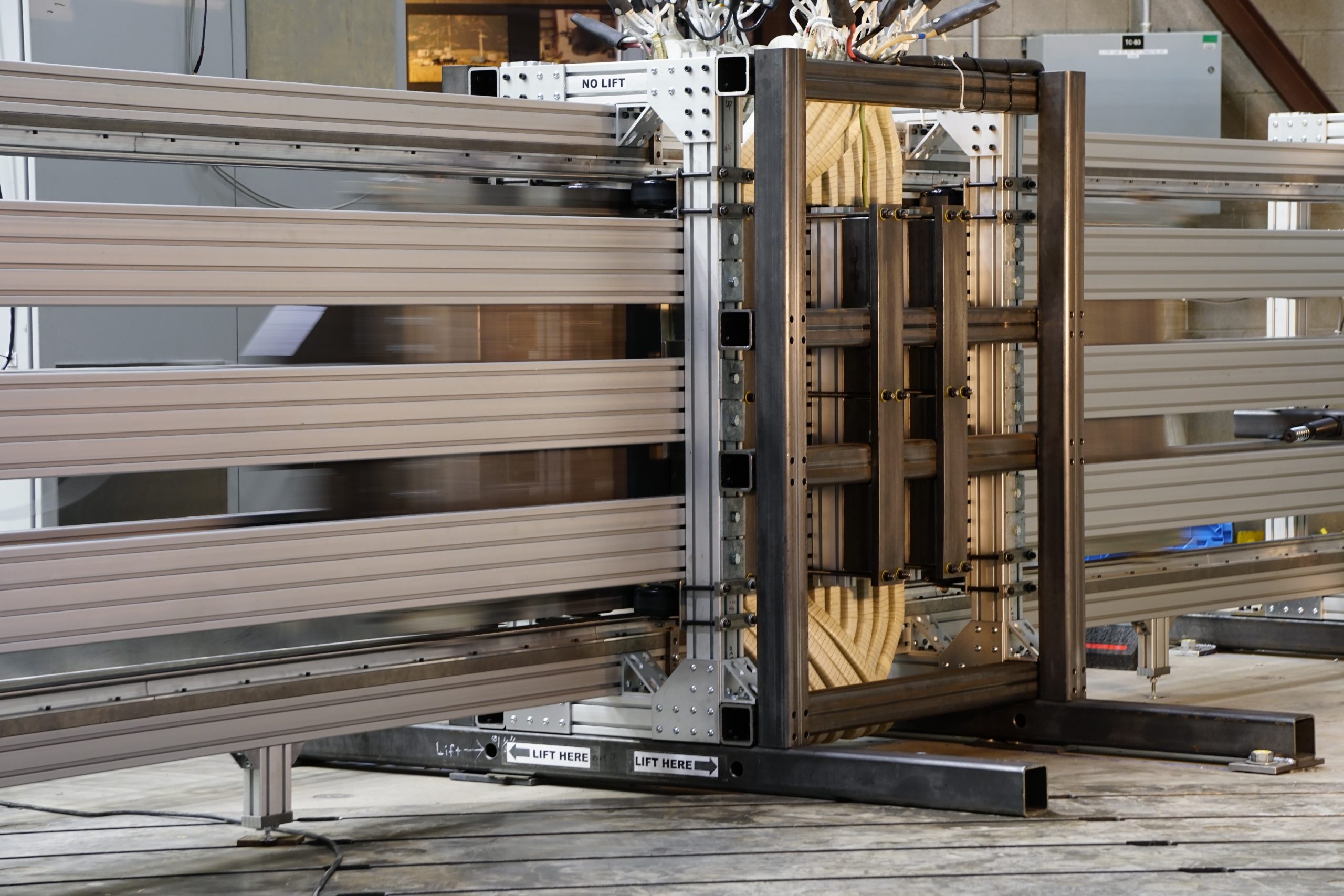
The Vernier architecture reaches high efficiency at the low speeds and high forces of wave motion while using far less active material than a conventional direct-drive linear generator. That cuts cost and reduces exposure to neodymium price volatility. The control strategy was co-designed with the machine rather than retrofitted to it.
Reduction in active materials versus a conventional direct-drive linear generator:
Each milestone reduces risk in the next. LN4 in-water data feeds the LN12 commercial design.
First test of the 60 kW, 2 m-stroke prototype PTO completed at the National Renewable Energy Laboratory’s Flatirons campus, under an earlier DOE-supported program.
Selected for $1.8M in US Department of Energy support to complete the WEC design and begin prototype certification against IEC and IEEE standards.
Partnership with TTI Marine Renewables to integrate NetBuoy, the lightweight, low-cost, durable prime mover.
Wave-tank testing at 1:20 scale at the University of New Hampshire validated the numerical models behind the design.
US DOE SBIR support for the co-development of wave energy and modular floating desalination, the near-term deployment pathway.
DNV issued a Statement of Feasibility under DNV-SE-0120. The review now covers the LumaNet design.
The LN4 subscale demonstrator targets in-water operation, the first deployment of the LUMA platform and the source of validation data for the commercial design.
The LN12 commercial unit, scaled from the validated LN4 design, on a costed pathway to commercial competitiveness.
A direct-drive Vernier permanent-magnet linear generator developed with McCleer Power. It converts wave motion straight to electricity, offers four-quadrant control, and is protected by multiple granted patents in the US and Europe.
Hydraulic and geared power take-offs add mechanical layers that historically made wave energy unreliable and reduced controllability. Direct drive removes those components. It suits the low speeds and high forces of wave motion, and it is finely controllable in both force and position.
The LN4 is a subscale demonstrator built to gain deployment experience and validate the analytical methods used for the commercial design. The LN12 is the commercial machine. They share a common power take-off philosophy, so LN4 in-water data feeds the LN12 design directly.
DNV issued a Statement of Feasibility under DNV-SE-0120 in December 2025. The engagement now covers the LumaNet design on a pathway toward prototype certification.
The LumaNet is designed for a 25-year life. There is no personnel entry to the housing at sea; internal maintenance is done by retrieving the full device.